SEO vs AEO vs GEO: What Businesses Need to Know in 2026
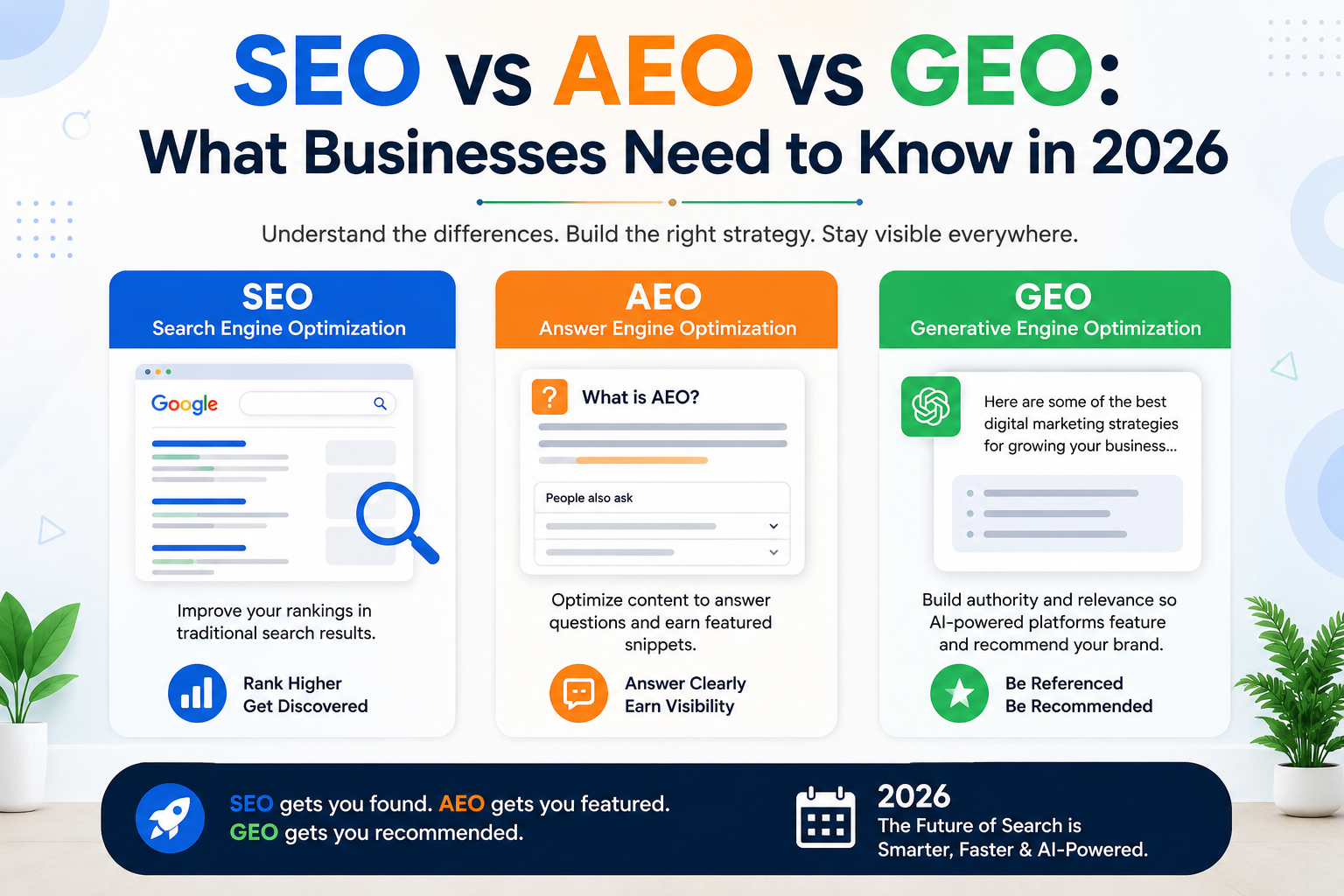
SEO vs AEO vs GEO: What Businesses Need to Know in 2026
Search is changing fast. Learn how SEO, AEO, and GEO can help businesses stay visible across Google and AI-powered search platforms in 2026.
Search is no longer limited to typing keywords into Google and clicking a website from the results. Today, users are increasingly asking complete questions and expecting direct, useful answers. Google AI Overviews, ChatGPT, Gemini, Perplexity, and other AI-powered platforms are changing how people discover information, products, and services.
This change has introduced new opportunities for businesses. Traditional SEO (Search Engine Optimization) remains important, but businesses also need to think about AEO (Answer Engine Optimization) and GEO (Generative Engine Optimization).
So, what is the difference between SEO, AEO, and GEO? Are they separate strategies or parts of the same digital marketing approach?
The simple answer is that all three focus on improving online visibility, but they target different search experiences.
What Is SEO?
SEO, or Search Engine Optimization, is the process of improving a website so that it can achieve better visibility in search engine results.
Traditional SEO focuses on helping search engines understand a website and determine its relevance and authority for specific search queries.
Important SEO activities include:
- Keyword research
- On-page optimization
- Technical SEO
- Internal linking
- Content optimization
- Website speed and mobile usability
- Backlink building
- Local SEO
- User experience
- E-E-A-T signals
For example, a company targeting the keyword digital marketing agency in Delhi may optimize its service pages, create relevant blogs, improve internal links, and build authority around digital marketing topics.
SEO is still the foundation of online visibility in 2026. However, ranking on a search engine is no longer the only objective.
Businesses now also need to make their content easy for answer engines and AI systems to understand.
What Is AEO?
AEO stands for Answer Engine Optimization.
AEO focuses on creating content that directly answers questions users are searching for.
Instead of only targeting keywords such as "digital marketing services," AEO considers conversational queries such as:
- "What does a digital marketing agency do?"
- "How much does digital marketing cost?"
- "Which digital marketing services does a small business need?"
AEO content usually provides clear answers near the beginning of a section. This makes the information easier for search engines and answer engines to understand.
Common AEO techniques include:
- Creating question-based headings
- Providing concise answers
- Adding FAQs
- Using structured content
- Answering specific search intent
- Using simple and natural language
- Supporting answers with relevant information
- Organizing content with clear H2 and H3 headings
For example, if your heading is "What is AEO?", the paragraph immediately below should provide a direct definition before expanding on the topic.
This approach can improve the chances of appearing in featured snippets, People Also Ask results, and other answer-focused search experiences.
What Is GEO?
GEO stands for Generative Engine Optimization.
GEO is focused on improving the chances of a brand, website, or content source being understood, referenced, or mentioned by generative AI search systems.
Users are increasingly asking AI platforms questions such as:
- "Suggest digital marketing agencies for a growing business."
- "What services should a startup look for in a marketing agency?"
- "How can a local business improve online visibility?"
Instead of showing only a traditional list of links, generative search can provide a synthesized answer.
This means brands need to build strong topical authority and provide useful, trustworthy and clearly structured information.
GEO can involve:
- Building topical authority
- Demonstrating expertise
- Creating original and useful content
- Providing factual information
- Using clear entity and brand information
- Covering related questions
- Maintaining consistent brand information
- Creating content around specific topics rather than isolated keywords
SEO vs AEO vs GEO: What Is the Difference?
Although SEO, AEO, and GEO overlap, their primary objectives are different.
| Strategy | Main Focus | Typical Search Experience |
|---|---|---|
| SEO | Search engine rankings | Traditional search results |
| AEO | Direct answers | Featured snippets, FAQs, and answer results |
| GEO | AI-generated visibility | Generative AI and AI search |
Think of them as three layers of modern search optimization.
SEO helps your website become discoverable.
AEO helps your content become answer-friendly.
GEO helps your brand become visible in generative search experiences.
Why Businesses Need SEO, AEO and GEO Together
Businesses should not treat SEO, AEO, and GEO as completely separate marketing activities.
A strong SEO strategy creates the foundation. AEO makes information easier to extract and understand. GEO extends the strategy toward AI-powered discovery.
For example, a company can create a detailed service page for SEO services in Delhi.
The page can be optimized for traditional search through relevant keywords, internal links, and technical SEO.
It can then include direct answers to questions such as:
- "What does an SEO company do?"
- "How long does SEO take?"
- "What is included in SEO services?"
This supports AEO.
The same page can demonstrate experience, explain the company's approach, provide useful information, and establish clear brand entities. This can support GEO-oriented visibility.
How to Create SEO, AEO and GEO-Friendly Content in 2026
1. Start With Search Intent
Do not create content simply because a keyword has search volume.
Understand why someone is searching.
Is the user looking for information, comparing options, researching a service or preparing to make a purchase?
Content should satisfy the actual intent behind the query.
2. Answer the Main Question Early
Avoid making readers go through 500 words before finding the answer.
Start important sections with a concise answer and then provide supporting details.
This creates a better experience for users and makes the content easier for search systems to interpret.
3. Use Conversational Questions
People increasingly search using natural-language questions.
Instead of focusing only on:
"SEO agency Delhi"
also consider questions such as:
"How can an SEO agency improve my website rankings?"
This helps create content that is useful for both traditional and conversational search.
4. Build Topical Authority
One article is rarely enough to establish strong authority around a competitive topic.
Create related content covering different aspects of the subject.
For example, a digital marketing website can publish content around:
- SEO
- Local SEO
- Technical SEO
- Content marketing
- AEO
- GEO
- Social media marketing
- Performance marketing
- Website optimization
Connect related pages through relevant internal links.
5. Focus on Experience and Trust
AI-friendly content should not mean generic content.
Include practical examples, original insights, real processes, expert opinions, and useful data wherever appropriate.
Content should demonstrate why readers should trust the information.
6. Keep Information Clear and Structured
Use:
- Short paragraphs
- Descriptive headings
- Bullet points
- Tables
- FAQs
- Definitions
- Examples
Well-structured content is easier for both humans and machines to understand.
For example, Maverick India should consistently communicate its digital marketing capabilities and areas of expertise across relevant website pages and content.
Common SEO, AEO, and GEO Mistakes
Businesses often make the mistake of treating AI search optimization as simply adding more keywords.
Keyword stuffing does not create useful content.
Other common mistakes include:
- Publishing generic AI-generated articles
- Ignoring search intent
- Creating repetitive content
- Using outdated information
- Writing without expert input
- Neglecting technical SEO
- Having inconsistent brand information
- Ignoring local search
- Creating content only for search engines
The goal should always be to create genuinely useful content first and optimize it intelligently.
Frequently Asked Questions
Conclusion
Search optimization is entering a new phase in 2026. Businesses can no longer think only about where a webpage ranks for a particular keyword.
Modern search visibility involves being discoverable, answerable and understandable across different search experiences.
SEO remains the foundation for traditional search visibility. AEO helps businesses provide direct and useful answers, while GEO focuses on visibility within generative AI experiences.
The strongest strategy is not to choose one over another. Instead, businesses should create high-quality content that satisfies users, demonstrates expertise, and provides clear information that search engines and AI systems can understand.
For businesses planning their digital strategy in 2026, combining SEO, AEO and GEO can create a more comprehensive approach to search visibility and long-term online growth.