What Is a 360-Degree Advertising Marketing Agency and What Does It Do?
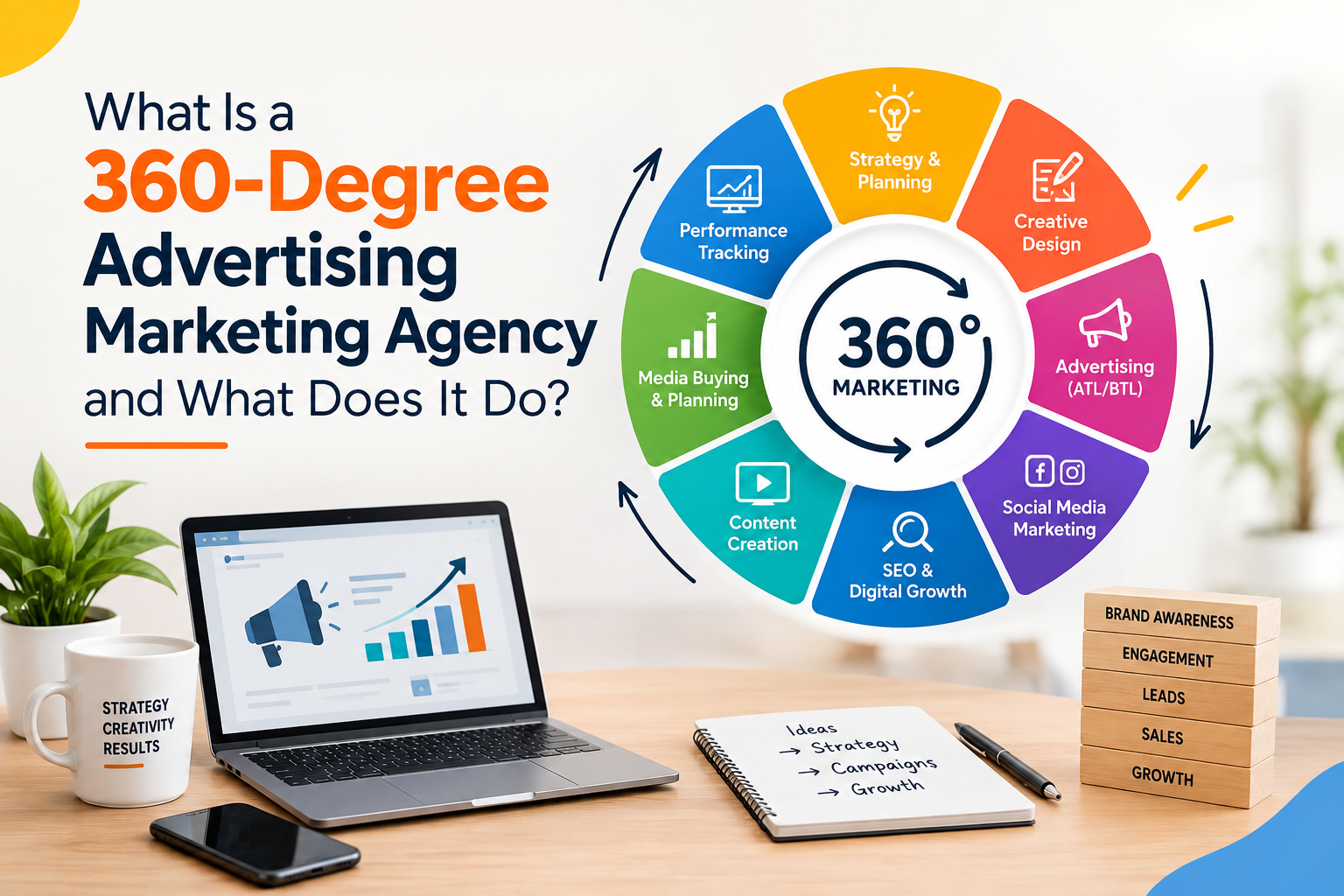
What Is a 360-Degree Advertising Marketing Agency and What Does It Do?
In today's competitive market, businesses need more than a single advertising campaign to reach customers. They need a connected strategy that covers digital marketing, branding, creative communication, social media, media planning, and customer engagement. This is where a 360-degree Advertising Marketing Agency becomes useful.
A 360-degree approach brings different marketing activities under one strategy. Instead of managing multiple agencies for different requirements, a business can work with one Advertising Marketing Agency that understands the complete customer journey.
For businesses looking for an Advertising Agency in Delhi or a Marketing Agency in Delhi, this integrated approach can help maintain consistency across different marketing channels.
What Is a 360-Degree Advertising Marketing Agency?
A 360-degree advertising and marketing agency provides a complete range of marketing and advertising solutions through a unified strategy. It can combine traditional advertising, digital marketing, creative services, branding, public relations, social media, content, and performance-focused campaigns.
The main idea is simple: every marketing activity should work together toward common business goals.
For example, a company launching a new product may need a creative campaign, social media promotion, website content, paid advertising, outdoor advertising, influencer communication, and public relations. A 360-degree agency can plan these activities together instead of treating them as separate campaigns.
How Does a 360-Degree Marketing Agency Work?
A professional Marketing Agency generally starts by understanding the business, target audience, competitors, products, market position, and marketing objectives.
After research, the agency develops a strategy based on the customer journey.
The process may include:
Understanding business and marketing goals
Identifying the target audience
Researching competitors and market trends
Developing the campaign strategy
Creating brand and advertising communication
Selecting suitable marketing channels
Launching campaigns
Tracking performance
Analysing customer response
Improving the strategy based on results
This integrated process helps businesses keep their communication consistent across different platforms.
Services Offered by a 360-Degree Advertising Marketing Agency
A 360-degree agency can offer several services depending on the business requirement.
1. Digital Marketing
Digital marketing is an important part of modern advertising. It may include SEO, search engine marketing, social media marketing, content marketing, email marketing, online reputation management, and performance marketing.
These activities help businesses build online visibility and connect with potential customers.
2. Search Engine Optimization
SEO helps businesses improve their organic visibility on search engines. An agency may work on technical SEO, on-page optimization, content creation, keyword research, local SEO, and link-building activities.
For businesses targeting specific locations, local SEO can also support visibility for searches such as Advertising Agency in Delhi and Marketing Agency in Delhi.
3. Social Media Marketing
Social media provides an opportunity to communicate directly with customers. A 360-degree agency can develop social media strategies, create posts and creatives, manage campaigns, and analyse engagement.
The content can be designed according to different platforms and audience groups.
4. Creative and Branding Services
Creative communication plays an important role in advertising. Agencies may develop logos, campaign concepts, brand messaging, brochures, social media creatives, banners, videos, and other marketing assets.
Consistent creative communication helps a brand maintain a recognisable identity.
5. Traditional Advertising
A 360-degree approach does not focus only on digital platforms. Depending on the target audience, businesses may also use newspapers, magazines, radio, television, outdoor advertising, transit advertising, and other offline channels.
The agency can help select suitable channels based on campaign objectives and audience behaviour.
6. Performance Marketing
Performance marketing focuses on measurable digital campaigns. It can include search advertising, social media advertising, remarketing, lead-generation campaigns, and other paid digital activities.
Campaign performance can be monitored using metrics such as clicks, leads, conversions, cost per lead, and return on advertising spend.
7. Content Marketing
Useful and relevant content can help businesses answer customer questions and build online visibility. A marketing agency may create blogs, articles, landing pages, social media content, videos, infographics, and other formats.
Content can also be structured for Google Search, Answer Engine Optimization (AEO), and Generative Engine Optimization (GEO).
Why Do Businesses Choose a 360-Degree Advertising Agency?
One major advantage is integrated planning.
When advertising, branding, content, social media, and digital marketing are planned together, businesses can maintain a consistent brand message.
A 360-degree approach can also make campaign management easier. Instead of coordinating separate teams for every marketing activity, businesses can have a central agency managing multiple functions.
Another benefit is better understanding of the customer journey. A customer may first see a social media post, later search for the brand on Google, visit the website, and finally contact the business. A connected marketing strategy considers these different touchpoints.
What Makes an Advertising Marketing Agency Effective?
Choosing an agency should not be based only on the number of services it offers. Businesses should also consider strategy, communication, experience, creative capabilities, reporting, and understanding of the target market.
A capable agency should be able to explain:
What is the campaign objective?
Who is the target audience?
Which channels should be used?
What type of content is required?
How will campaign performance be measured?
How frequently will results be reviewed?
What improvements can be made?
Clear answers to these questions help businesses understand the overall marketing approach.
Advertising Agency vs Marketing Agency: Is There a Difference?
The terms Advertising Agency and Marketing Agency are often used interchangeably, but they can have different areas of focus.
An advertising agency may focus more heavily on paid communication and campaign execution across media channels.
A marketing agency generally takes a broader approach that can include market research, branding, SEO, content, social media, performance marketing, customer engagement, and advertising.
A 360-degree agency can combine both advertising and marketing functions under one integrated strategy.
Why Choose an Advertising Agency in Delhi?
Delhi is a major business and commercial market with companies operating across multiple industries. Businesses often need marketing strategies that can reach both local and wider audiences.
An Advertising Agency in Delhi can help businesses plan campaigns according to their target market, location, industry, and objectives.
Similarly, a Marketing Agency in Delhi can support digital visibility, branding, content, social media, advertising, and customer engagement through a coordinated approach.
For businesses such as startups, established brands, B2B companies, retail businesses, and service providers, the right marketing mix can vary significantly.
How Maverick India Supports Integrated Marketing
Maverick India focuses on combining strategy, creativity, and technology to help brands build stronger marketing communication.
Through an integrated approach, businesses can work on different aspects of their marketing requirements while maintaining a consistent brand message.
You can explore the services and marketing solutions offered by Maverick India.
The right approach depends on the business objective, target audience, budget, industry, and campaign requirements. A 360-degree strategy should therefore be customised instead of using the same marketing plan for every business.
Conclusion
A 360-degree Advertising Marketing Agency brings multiple marketing functions together under one strategic direction. From digital marketing and SEO to branding, social media, creative communication, performance marketing, and traditional advertising, the objective is to create a connected customer experience.
For businesses searching for an Advertising Agency, Marketing Agency, Advertising Agency in Delhi, or Marketing Agency in Delhi, an integrated approach can provide a structured way to manage different marketing activities.
The most suitable strategy ultimately depends on business goals, audience behaviour, market conditions, and measurable campaign objectives.